
WHAT IS MEDIATION?
Mediation is not a legal binding ADR but a consensual approach to resolve dispute by appointing a third party as a mediator that only attempt to facilitate the disputed parties into adopting a win-win situation to move forward regardless of their legal positions. Mediation as an ADR is provided in most local standard forms of contract for example the PAM Form and the CIDB Standard Form of Contract, now AIAC Standard form of Building Contract.

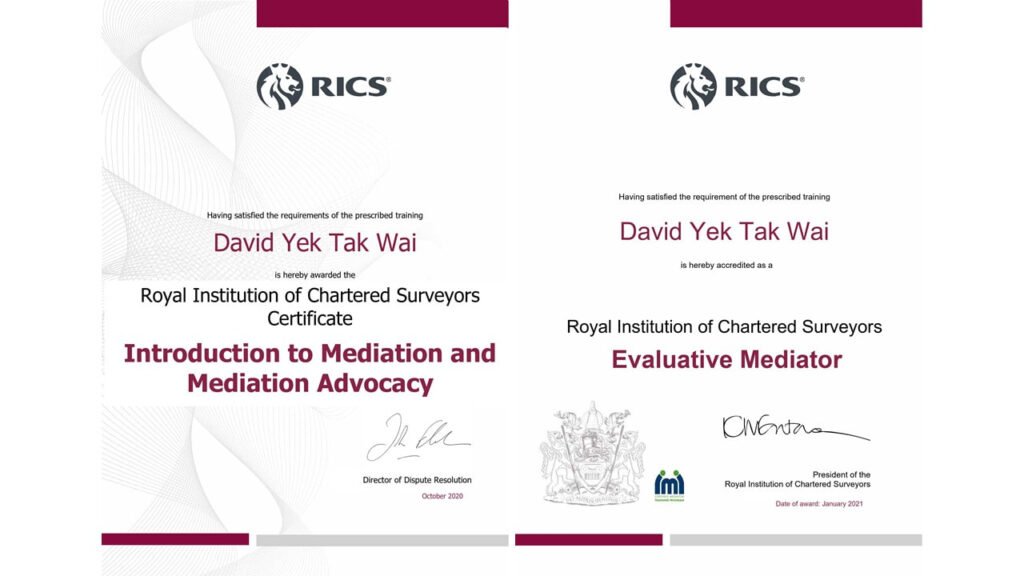
"Mr Yek had a very positive outlook throughout and his manner was engaging and helpful. He understood the mediation process, the evaluative aspect to mediation and the strength of reality checking." - RICS (2020)


THE FUTURE IN MEDIATION
- A settlement agreement may be enforced directly by the courts of a State;
- Where the assets are located such that execution may also be sought if the enforcement process is successful and
- Prevents potential multiple proceedings.
- The settlement agreement is in writing;
- Results from a mediation;
- Relating to consumer transactions nor to family, inheritance or employment law;
- That have been approved by a court or concluded in the course of proceedings before a court and that are enforceable as a judgment in the State of that court; or
- That have been recorded and are enforceable as an arbitral award.
MEDIATION IN MALAYSIA
Mediation in Malaysia was established under the Malaysian Mediation Centre (MMC) in 1999, to promote mediation as a means of dispute resolution and to provide a proper avenue for successful dispute resolutions, currently under the auspice of the Malaysian Bar. The centre provides mediation services by trained mediators who have been accredited and appointed to the Panel of Mediators at MMC. Further enforced by the Mediation Act 2012 gazetted on 1 August 2012, to promote and encourage mediation as a method of alternative dispute resolution by providing for the process of mediation, thereby facilitating the parties in disputes to settle disputes in a fair, speedy and cost-effective manner and to provide for related matters.
Not every dispute has to be 'legal', it is sometimes better to negotiate and mediate on terms that can provide a 'win-win' situation to both parties. Ultimately, moving forward with the retention of good-wills and relationships are far better of compared to the 'zero-sum' approach of legal 'litigation', that in the ends only enrich the legal representatives...
Disadvantages
- Non-legal binding
- Settlement Agreement subject to enforcement
- Could be expansive
- Legal rights are often ignored
- May subject to ‘high handed’ approach by unprofessionally trained mediator
- No guarantee of success and parties may not walk out with a resolution
Advantages
- Greater Control
- Private and Confidential
- It is Voluntarily
- Convenience
- Faster Outcome
- Professional Support
- Exclusion of Legal Representatives
- Preservation of Relationship & Goodwill