

Objective of this Page
Building Codes comprise of a significant amount of legislation controlling the building industry i.e. Planning, HDA, Strata and Strata Management… I am sharing these information with a caveat that these information is for educational purpose only and shall not be taken as an advice be it legal or otherwise. You should seek proper advice to your case with the relevant professionals. The author cannot guarantee the accuracy of the information so provided here.
Archives
Categories
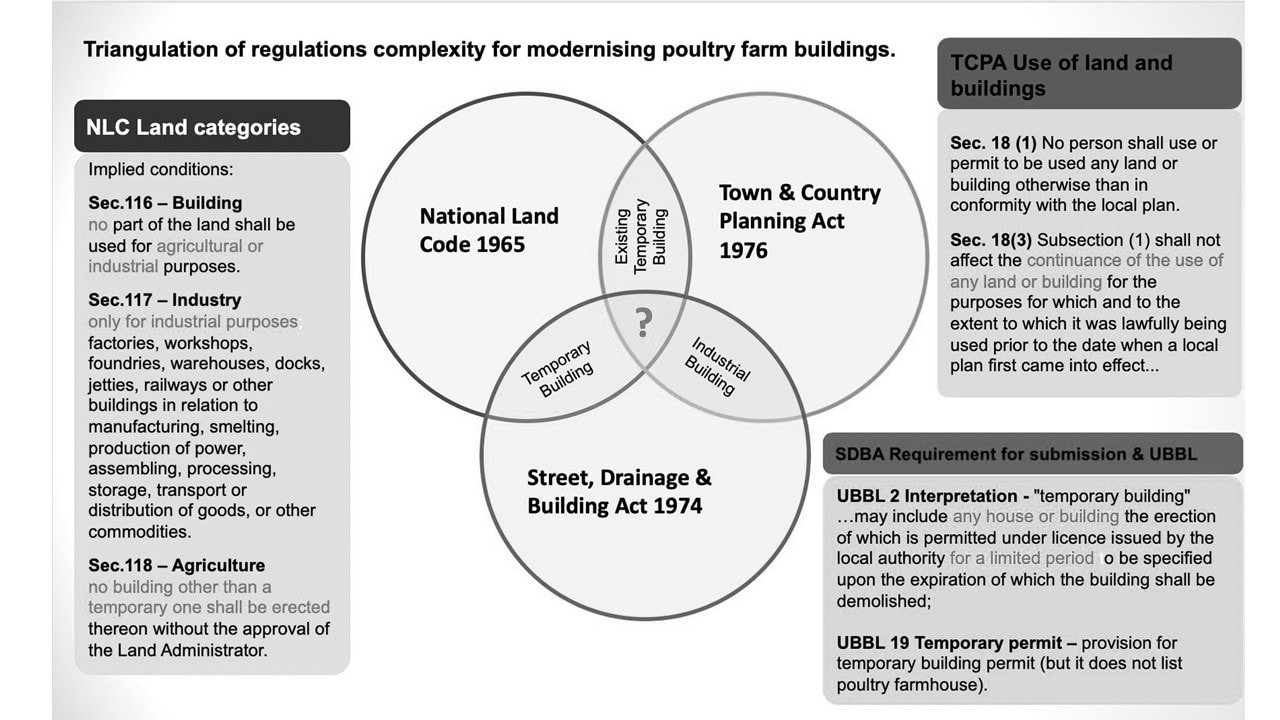
THE ISSUES
THE LAW
TCPA provided for [permitted] in conformity to ‘local plan’.[4]
SDBA provided under the Uniform Building Bylaws 1984 UBBL that a ‘temporary building’ is a building under license from the local authorities for a specific period, only to be renewable upon expiry.[5] It furthers provide the ‘temporary permit’ excluding a category of ‘poultry farm’.[6]
………………………………..
[1] S.116 NLC
[2] S.117 NLC
[3] S.118 NLC
[4] S.18(1) TCPA
[5] UBBL 2
[6] UBBL 19
THE APPLICATION
Upon the granting of Planning Permission, only the NLC takes effect. There is very little ambiguity on this ‘level of priority’ in the interpretation of both legislation. Application wise, it is the onus of the ‘land surveyors’ to execute this part of the exercise.
Assuming that D.Arzumi’s land has now changed to agriculture and the implied conditions are for agriculture, that no building shall be erected on the land other than the building […] referred to subsection 4[1], which for the purpose of dwelling house of the proprietor[2]. In D.Arzumi’s case, he can build a ‘building’ but it must be ‘temporary in nature’.[3]
When D.Arzumi’s Architect is called to submit the building plans for approval, it has to again, go through the provision of TCPA for the ‘Planning Permission for the Erection of Building’ and upon granting of such, he can proceed to submit to the local authorities under the provision of the UBBL. Here, the true contention of a ‘temporary building’ is a building constructed in ‘temporary building materials’[4] such as ‘wooden house’ whereas a ‘temporary permits’ gave all discretion to the local authorities if the ‘building’ does not fall within the classification of UBBL19(1).[5]
…………………………………
[1] S.115(1)(a) NLC
[2] S.115(4)(a) NLC
[3] S.118 NLC
[4] UBBL 2:Intepretation, ‘[…]of materials[…] liable to rapid deterioration[…]’
[5] UBBL19(2)
THE CONCLUSION
P/S: Graphics from ‘open source’, , credited to Datuk Ar. Ezumi.[1]
………………………………….
[1]facebook.com/photo.php?fbid=10224470157242874&set=a.1066827632333&type=3&theater&ifg=1