


ATTEMPTING LLM DISSERTATION: WHERE TO START
Embarking LLM Dissertation is a steep learning curve. Foremost, one has to deal with ‘research methodology’, a subject warrant an independent study by itself. Second, your supervisor (‘Sv’) who sometimes acted like a ‘zen master’, very little word and it is priceless when he instruct you and you have to come out with the rest of the ‘instruction’. Third, your school preferences, as different level of dissertation required different things and don’t pretend you are writing a PhD research when you are actually dealing with only the LLM. Fourth, your materials, something that I will write about as I move on.
THE RESEARCH PROPOSAL (‘RP’)
This is the first step that the school require you to submit. Each school has its format, so stick with that. In the RGU, this RP constitute the Chapter-01 of your dissertation. Generally, it requires you to submit the following items for the school’s consideration:
- Provisional Title of Research
- Background to the Conducting such Research
- Research Problem(s)
- Aims and Objective(s)
- Methodology
- Proposed Chapters
- Proposed Literature Reviews
- Proposed Bibliography
LITERATURE REVIEW (‘LR’)
Nobody would jump straight to proposed a title. More importantly is to:
- Intuitively know which area of law you would prefer to write;
- Collect articles, journals and books relating to such an area of law you which to write
- Read through each of these articles, journals and books, decipher its content that related to such an area of law you which to write; and
- Ponder again and restructure […].
For example, in my case:
- Area of law: Alternative Dispute Resolution (‘ADR’), but there are many kinds of ADR. I had chosen Arbitration, as there are plenty of literature available on this topic;
- Too many, in fact that I have to narrow down to, Arbitration in the Construction Industry of Malaysia;
- Having said that it is still too wide and RGU required students to compare and critically analyse or review, so there must be a subject for comparison;
- Thus I had taken to critically compared, review and analyse, collectively known as ‘investigating’, the subject of Malaysia Institute of Architects (‘PAM’) as an arbitral appointing body for the Construction Industry of Malaysia;
- Having considered two-subject matters as comparison, the next issues were, in which area must I investigate?
- So, I have to lay-out the matrix, Arbitration > Construction Industry > Malaysia > PAM > [‘the area of concerns which make PAM function as an arbitral appointing body’]; and
- Having considered these matrix, the ‘area of concerns’ are:
- The Legal Framework
- The Arbitration Agreement [Dispute Clause]
- The Arbitration-Rules
- The Qualification, Ethics, Conducts and Administration
At this point I will temporary halt my discussion of LR and jump to another consideration.
AIMS AND OBJECTIVES (‘A&O’)
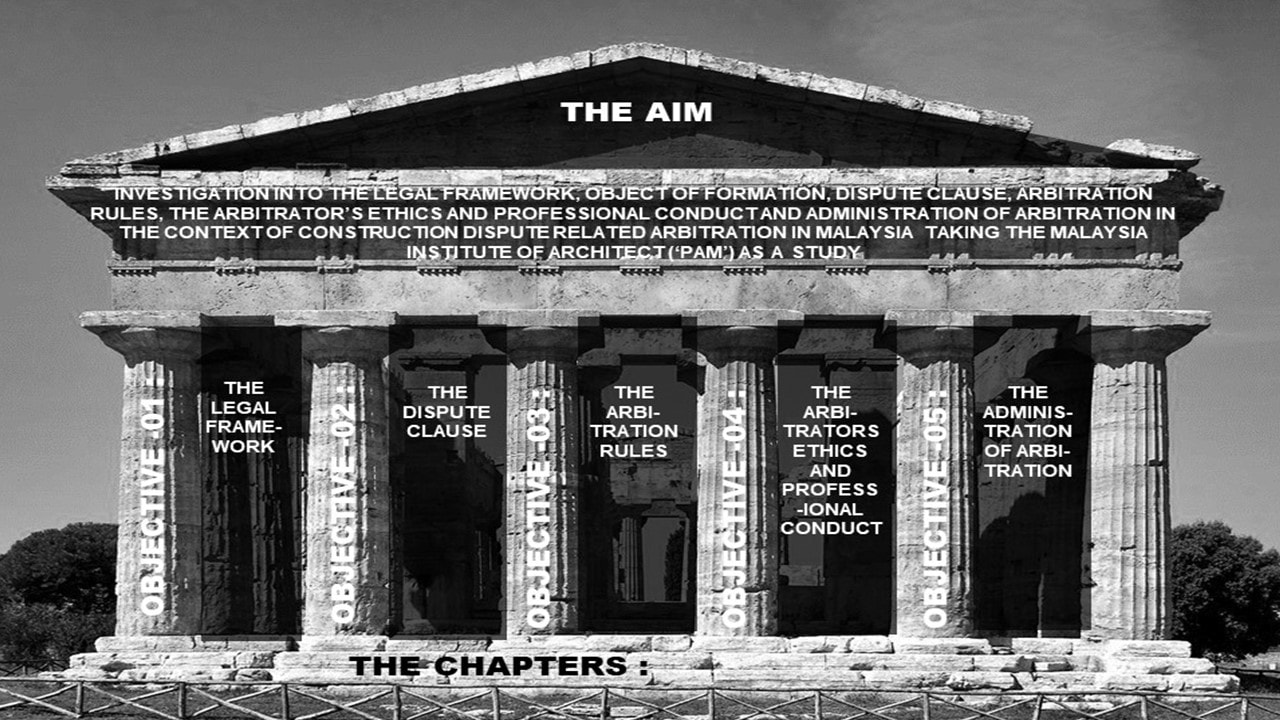
The ‘area of concerns’ are actually my ‘objectives’. These 4-objectives are my ‘pillars’ to support my ‘research aim’. What is my ‘research-aim’ then? Taking the same act of investigating, I rephrased my aim to also include my objectives as:
[T]his research aims to investigate the legal framework and the object of formation of the arbitral appointing body, dispute clause, arbitration rules, the arbitrator’s ethics and professional conduct and the administration of arbitration in the context of construction dispute arbitration in Malaysia taking PAM as a study.
[T]his research aims to investigate the legal framework and the object of formation of the arbitral appointing body, dispute clause, arbitration rules, the arbitrator’s ethics and professional conduct and the administration of arbitration in the context of construction dispute arbitration in Malaysia taking PAM as a study.
RESEARCH TITLE
Needless to say, my research title will be called:
[I]nvestigation into the legal framework and the object of formation of the arbitral appointing body, dispute clause, arbitration rules, the arbitrator’s ethics and professional conduct and the administration of arbitration in the context of construction dispute arbitration in Malaysia taking PAM as a study.
[I]nvestigation into the legal framework and the object of formation of the arbitral appointing body, dispute clause, arbitration rules, the arbitrator’s ethics and professional conduct and the administration of arbitration in the context of construction dispute arbitration in Malaysia taking PAM as a study.
METHODOLOGY
The RGU imposed a methodology for Legal Research limited to only ‘doctrinal approach’, meaning qualitative-research based on secondary sources are to be conducted and such ‘doctrinal approach’ forms the basis of limitation in this research.[1] Therefore, the supposing Chapter-03 on Research Methodology is now being irrelevant.
———————————-
[1] RGU law School, ‘BSM587 PG Dissertation Handbook 2021-22’ (RGU 2021) p.4: not permitted to undertake any fieldworks or data collection of your own.
PROPOSED CHAPTERS
Chapters in dissertation are commonly comprise of Introduction, literature review, methodology, results and discussion, conclusions and outcomes (recommendations).[1] However, in view of the limitation set from the onset by the RGU, the chapters are comprised of Introduction, literature review, discussion and conclusions.[2] Since there is a word-limit set at 15,000 words threshold, all Chapters from Chapter-02 onwards shall contain at least one objective. These chapters are the bed-rocks for the objectives and in return, these objectives are the columns upholding the pediment of the research aims or the title of your research.
——————————-
[1] All Answers Ltd, ‘Writing a Law Dissertation – what is expected?’ (Lawteacher.net, November 2021) <https://www.lawteacher.net/law-help/dissertation/writing-a-dissertation-what-is-expected.php?vref=1> accessed 1 November 2021.
[2] RGU law School, ‘BSM587 PG (Law) Dissertation Guidance Notes’ (RGU 2021) p.7-10.